

Written by: Dr. Ahmed Al-Ahmed, Attorney at Law
Delaware corporate law is widely regarded as the gold standard for corporate governance, largely due to its sophisticated judiciary and well-developed legal doctrines. Yet, the observation by a Delaware jurist regarding “persistent inconsistencies” is not without merit. Several areas of the law reveal tensions that can lead to unpredictable outcomes in practice. The following analysis highlights key examples of these inconsistencies and their implications.
- Fiduciary Duties of Care and Loyalty
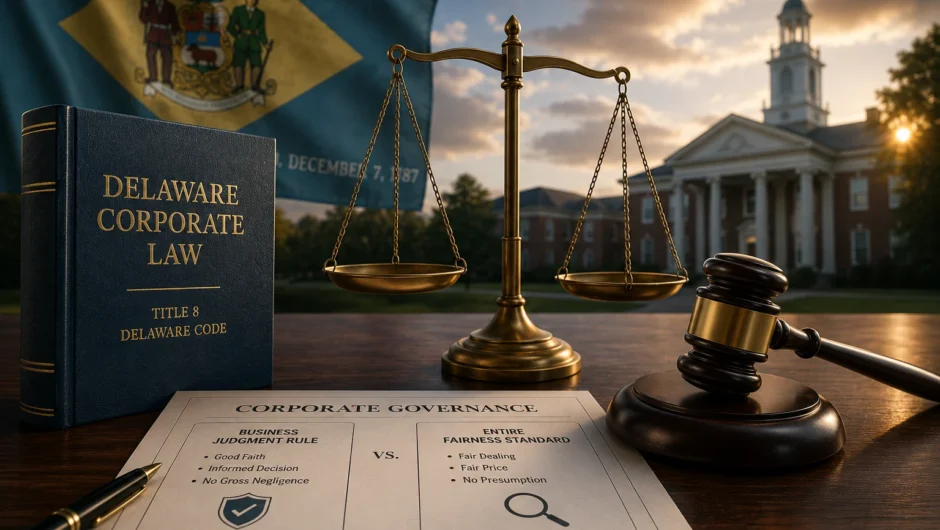
Delaware imposes two core fiduciary duties on directors: the duty of care, protected by the Business Judgment Rule (BJR), and the duty of loyalty, evaluated under the Entire Fairness Standard. Although both duties aim to safeguard corporate interests, they can produce conflicting results when applied to the same set of facts.
Process vs. Outcome
- Business Judgment Rule (BJR):
The BJR focuses on process. Directors must act with the care of a reasonably prudent person, relying on adequate information and proper deliberation. Courts defer to directors’ decisions unless plaintiffs demonstrate gross negligence.
- Entire Fairness Standard:
The entire fairness standard focuses on outcome. When conflicts of interest or self-dealing arise, directors must prove both fair dealing (process) and fair price (substance). Courts do not defer to directors in these cases.
Points of Inconsistency
- Presumptions:
BJR presumes directors acted in good faith. Entire fairness presumes the opposite; directors must affirmatively prove fairness.
- Scope of Application:
BJR applies broadly to most decisions absent conflicts of interest. Entire fairness applies narrowly to transactions involving self-dealing or material conflicts. The same decision may be analyzed under different standards depending on how plaintiffs frame their claims.
- Combined Claims:
Plaintiffs often allege both care and loyalty breaches, arguing procedural flaws and conflicts of interest simultaneously. This dual approach complicates judicial analysis and creates uncertainty for directors attempting to anticipate the applicable standard.
Potential Solutions
Courts could reduce inconsistency by clarifying when entire fairness supplants the BJR. For example:
- Apply entire fairness only when conflicts are material and involve direct self-dealing.
- In mixed care-and-loyalty cases, adopt a middle-ground standard, such as Revlon enhanced scrutiny, to evaluate both procedural integrity and substantive fairness without automatically requiring directors to prove entire fairness unless conflicts are egregious.
- Fiduciary Duties During Tender Offers: Unocal vs. Revlon
Delaware law imposes different fiduciary obligations depending on whether a company faces a hostile tender offer or is actively pursuing a sale.
Unocal/Unitrin Standard
Under Unocal v. Mesa Petroleum (1985) and Unitrin v. American General (1995), boards may adopt defensive measures if they reasonably perceive a threat to corporate policy or effectiveness. Directors may prioritize long-term strategy or corporate independence, even at the expense of immediate shareholder gains.
Revlon Standard
Once a company is “up for sale,” Revlon v. MacAndrews & Forbes (1986) requires directors to focus exclusively on maximizing shareholder value. Directors effectively become auctioneers tasked with securing the highest price.
The Tension
Boards often struggle to determine when Revlon duties are triggered. A board may initially rely on Unocal-based defenses, only to later discover that a sale has become inevitable requiring a sudden pivot to Revlon obligations. This shift can expose directors to litigation risk and accusations of misaligned priorities.
Possible Harmonization
Courts could apply enhanced scrutiny consistently across both contexts, examining:
- Under Unocal: the reasonableness of defensive measures in response to perceived threats.
- Under Revlon: the reasonableness of efforts to maximize value.
Using a unified analytical framework, while preserving the distinct emphases of each standard, may reduce uncertainty for boards navigating takeover scenarios.
- Securities Fraud: Delaware vs. Federal Law
Delaware’s approach to securities-related misconduct differs significantly from federal securities law, creating perceived inconsistencies when comparing the two systems.
No Delaware Equivalent to Rule 10b-5
Delaware lacks a broad statutory securities fraud provision like Rule 10b-5 under the Securities Exchange Act of 1934. Instead, securities-related claims are typically framed as:
- breaches of fiduciary duty,
- common-law fraud,
- equitable claims such as rescission or injunction.
Differences in Standards and Remedies
- Scienter Requirement:
Federal law requires proof of intent to defraud. Delaware fiduciary duty claims often succeed based on lack of good faith or loyalty breaches, even without intent.
- Available Remedies:
Delaware generally limits remedies to equitable relief. Federal law allows damages, creating a divergence in shareholder outcomes depending on the forum.
These differences do not necessarily reflect inconsistency within Delaware law itself, but they do create practical disparities for shareholders seeking redress.
Conclusion
The perceived inconsistencies in Delaware corporate law are not fundamental flaws. Rather, they reflect the flexible, fact-specific nature of Delaware jurisprudence, a system designed to adapt to complex corporate realities. Nonetheless, these inconsistencies can create uncertainty for directors, shareholders, and practitioners. Clearer judicial guidance, particularly regarding the boundaries between fiduciary standards, would enhance predictability while preserving Delaware’s strengths as the leading jurisdiction for corporate governance.